

COSMETIC DENTISTRY
Why Your Smile Plan May Involve More Than One Treatment
How Invisalign, veneers and missing-tooth replacement can form different parts of an individual treatment plan.
Could the changes you have in mind involve more than one kind of dental treatment?
You might be considering veneers because you would like a different tooth shape or colour, but tooth position may also need attention. Or you may want straighter teeth while needing a missing tooth replaced. These concerns do not necessarily have the same solution.
At Doncaster Hill Dental, we look at how your teeth, gums and bite work together before discussing an individual plan. If you are looking for a cosmetic dentist in Doncaster East, understanding the purpose of each option is a useful place to start.
Different concerns may need different approaches. The goal is not to provide more treatment, but to plan the appropriate treatment in the appropriate order.
Start with Your Health and Priorities
We begin by asking what you would like to change and what you would like to preserve. Natural differences in tooth shape and colour are normal; they do not automatically need treatment.
Assessment considers your oral health, existing restorations, tooth position and bite. Decay or gum disease may need attention before cosmetic options are considered. Some patients need only one treatment, some may benefit from a combination, and others may decide not to have cosmetic treatment.
Different Treatments Have Different Roles
Tooth position: Invisalign
Invisalign clear aligners move suitable teeth towards planned positions. Alignment and spacing may need consideration before the final shape of a restoration is decided. Clear aligners cannot address every alignment or bite problem; another orthodontic approach or specialist assessment may be appropriate.
Tooth shape and colour: veneers
Porcelain veneers cover the front surfaces of suitable teeth and can change aspects of shape, proportions and colour. They do not physically move teeth and are not a substitute for every orthodontic concern.
Depending on your priorities, whitening or small composite additions may be alternatives. Our composite veneers information explains the resin material also used for suitable bonded shape changes. Wanting whiter teeth does not, by itself, mean you need veneers.
Missing teeth: implant-supported replacement
An implant is placed in the jaw and may support a replacement crown where a tooth is missing. The implant provides support beneath the gum; the crown is the visible replacement tooth. Bridges, dentures or other approaches may also be considered. A veneer alone cannot replace a missing tooth.
A Patient Example: Invisalign First, Four Porcelain Veneers Afterwards
This patient’s treatment began with Invisalign to improve tooth alignment and positioning. After the orthodontic stage, four porcelain veneers were placed on the upper front teeth to refine their shape and proportions.
The photographs show the appearance before the combined treatment and after both stages. Invisalign and the veneers played different roles within the same treatment plan.
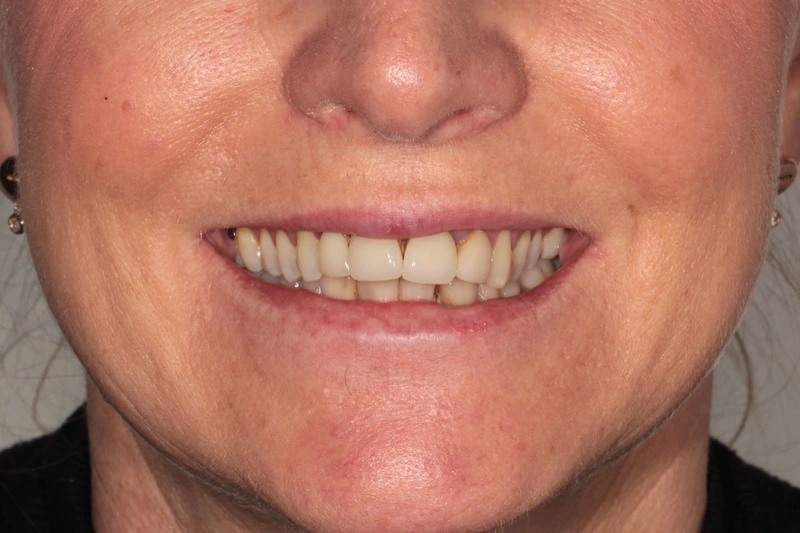
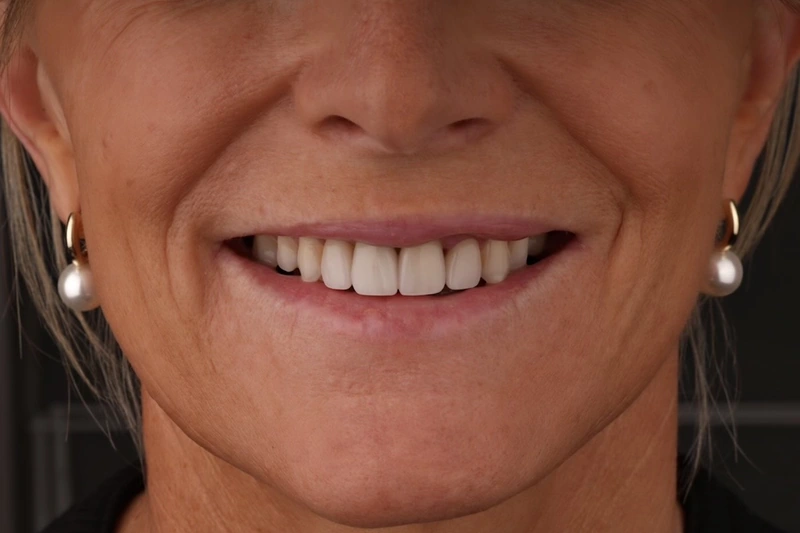
These photographs show one individual’s combined treatment. Suitability, treatment requirements, risks and outcomes vary. The photographs differ in lighting, camera angle and expression; they are not an exact photographic match.
- Stage 1: Invisalign.
Purpose: Improve tooth alignment and positioning. - Stage 2: Four upper front porcelain veneers.
Purpose: Refine the shape and appearance of selected teeth.
This patient received four veneers. That number is specific to their plan, rather than a recommendation for everyone. The final photograph shows both stages together; it does not show the result of Invisalign alone. You can see additional views in the full Invisalign and four-veneer case.
Why Might Invisalign Come Before Veneers?
Tooth position affects the space available for a restoration and how its proposed shape relates to neighbouring teeth. In selected cases, orthodontic treatment can be considered before deciding the final restorative approach.
For example, a tooth’s angle or the distribution of spaces may influence the shape that can be added comfortably. Reviewing position first allows the orthodontic and restorative parts of the plan to be considered together.
For some patients, alignment alone may address their concerns, without adding veneers. Finishing Invisalign is an opportunity to review your priorities, rather than an automatic step towards veneers.
The sequence depends on individual assessment. Invisalign does not guarantee that enamel preparation can be avoided. Veneers may involve irreversible changes to tooth structure, and enamel that is removed does not grow back.
Retainers and ongoing orthodontic review still need consideration after restorative treatment. If tooth shape changes, the team needs to plan how retainers will fit and maintain the tooth positions.
What If You Also Have a Missing Tooth?
A missing tooth introduces another planning consideration. This is a separate situation from the four-veneer case above, which illustrates alignment followed by veneers.
An implant-supported crown may be an option, depending on the tooth space, supporting bone and gums, oral health and individual assessment. Where orthodontics and tooth replacement are both being considered, the sequence should be planned together rather than treating the gap as an unrelated problem.
There is no universal order for every patient. Healing, additional care and the position of nearby teeth can affect the plan. A bridge, denture or another approach may be more suitable. Our dental implants page explains assessment, alternatives and ongoing care.
Your Treatment Planned Together at Our Doncaster East Practice
At Doncaster Hill Dental, we provide Invisalign, veneer treatment and dental implant care at our Doncaster East practice. Invisalign and veneers are treatments we regularly provide. This allows different parts of a plan to be discussed and coordinated by our team.
We explain the purpose of each proposed stage, who will provide it, and how follow-up will be arranged. Communication between the people involved helps keep the overall plan clear, with our team as your point of contact for questions.
Some situations may still require specialist input or referral. We will explain where that care will take place and how it relates to the other stages.
Think About Ongoing Care, Too
Each treatment has risks and responsibilities. Aligners can cause discomfort and require consistent wear and cleaning. Veneers can cause sensitivity, chip or loosen, and may need maintenance or replacement. Implant treatment involves surgery and healing, with risks including infection and implant failure.
We discuss the risks, recovery, alternatives and likely maintenance relevant to your plan before you decide. Daily cleaning, dental reviews and any recommended retainers remain important. You can take time to consider your options or seek a second opinion.
Start with a Conversation About Your Smile
You do not need to know which treatment to choose before your appointment. Tell us what you would like to change and what you would like to preserve. Our team can assess your teeth, explain suitable options and discuss whether one treatment or a coordinated plan may be appropriate.
82 Renshaw Street, Doncaster East VIC 3109
03 9840 2963


